Epistasia: a library for analizing binary landscapes
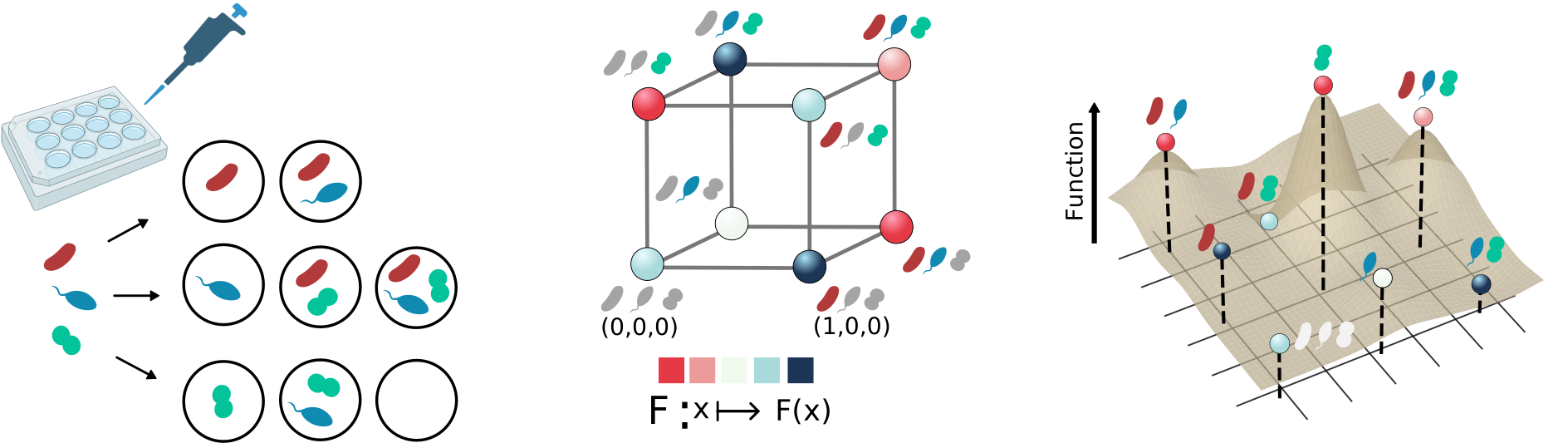
What is a landscape?
In ecology and genetics, we often deal with systems composed of several interacting components — such as species in a community, genes in a genome, or mutations in a genotype. Each component can be present (1) or absent (0), so the set of all possible configurations can be represented as
where \(N\) is the number of components, and the space contains \(2^N\) possible combinations.
A landscape is a mathematical function
that assigns a quantitative property to each configuration — for example, total biomass, growth rate, ecosystem productivity, or fitness. In biological terms, it tells us how the system performs depending on which components are active.
In practice, a landscape dataset consists of a collection of measured pairs \((\mathbf{x}, F)\), where each vector \(\mathbf{x} = (x_1, x_2, \ldots, x_N)\) indicates the presence (1) or absence (0) of each component, and \(F(\mathbf{x})\) is the measured outcome. Many experiments also include several replicates \(R\) for the same configuration, to account for experimental variability.
Such datasets form a discrete, high-dimensional map linking the composition of the system (e.g., which species or genes are present) to an emergent property at the system level. By analyzing these landscapes, we can uncover interactions, nonlinear effects, and higher-order dependencies that shape the collective behavior of complex biological systems.
What does Epistasia do?
Epistasia is a Python toolkit to analyze binary landscapes (genotype–phenotype or community–function maps) and quantify interactions across orders, from additive effects to higher-order terms.
Epistasia is designed around three core questions:
- Which local, context-dependent interactions can be detected given experimental noise?
- Which background-averaged interactions remain statistically identifiable across orders?
- Which interaction orders matter functionally, as quantified by the variance spectrum?
The library implements noise-aware estimators, bootstrap null models, and variance decompositions to address these questions in empirical, synthetic, and mechanistic landscapes. much of the functional variance is explained by additive and pairwise terms?*
Download epistasia
- From GitHub:
pip install "epistasia @ git+https://github.com/MCMateu/Epistasia.git"
Quick start
import epistasia as ep

L = ep.landscape_from_file("my_landscape.csv")   # x1..xN, F (and optionally replicate column)
out = ep.walsh_analysis(L)

ep.plot_variance_and_amplitude(out)
ep.plot_walsh_volcano(out)